
50 Football Coaching Mistakes Every Grassroots Coach Makes
- the-football-hub
- 1 day ago
- 8 min read

Grassroots football coaching is not easy.
Most coaches are volunteers balancing training sessions, matches, administration, parents and their own work and family commitments. They are often expected to develop players, manage behaviour, produce results and keep everyone happy... all with limited time, facilities and support.
Mistakes are therefore inevitable.
The important thing is not trying to become a perfect coach. It is being willing to reflect, recognise what could be improved and make small changes over time.
Many of the most common coaching mistakes are not caused by a lack of effort. They usually happen because coaches care so much that they try to control every detail. They talk too much, include too much content or place too much pressure on themselves and their players.
Here are 50 common mistakes made by grassroots football coaches and what you can do differently.
Session Planning Mistakes
1. Starting without a clear objective
A collection of enjoyable drills does not automatically create an effective session. Decide what you want your players to improve, then make sure each activity supports that objective.
2. Trying to coach too many things
Passing, pressing, finishing, defending and fitness cannot all receive meaningful attention in one hour. Choose one main theme and reinforce it throughout the session.
3. Making activities too complicated
A practice should challenge the players, not confuse them. If the explanation requires several minutes and multiple conditions, the activity probably needs simplifying.
4. Copying drills without understanding them
A drill that looks impressive online may not suit your players, numbers or learning objective. Understand why an activity works before adding it to your session.
5. Ignoring the players’ age and ability
Sessions should be adapted to the group in front of you. Younger and less experienced players need simpler instructions, more repetition and greater freedom to explore.
6. Planning every minute too rigidly
A session plan should provide direction, not become a script that cannot be changed. Be prepared to extend an activity that is working or simplify one that is not.
7. Using the same session structure every week
Consistency can help players, but repetition without variation can become predictable. Change the challenge, pitch shape, scoring system or player numbers while retaining familiar principles.
8. Failing to prepare for different attendance numbers
Grassroots attendance can change at short notice. Have a version of each activity that works with fewer or additional players.
9. Forgetting about equipment and space
A good session on paper can quickly fail if it requires four goals and half a pitch that are not available. Plan around the environment you will actually have.
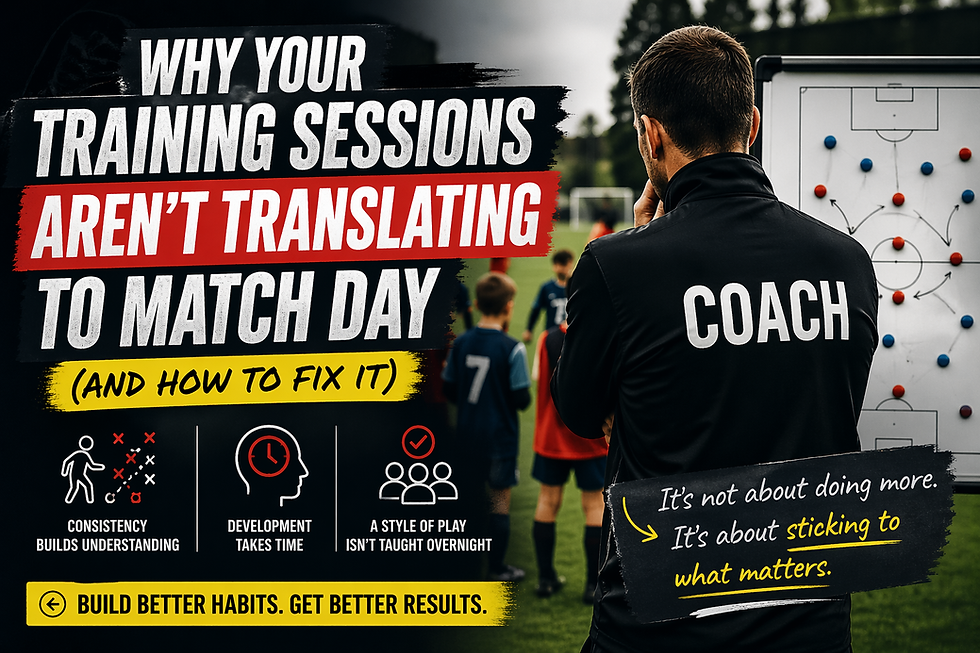
10. Not connecting training to the game
Players should understand where the session theme appears on matchday. Practices become more meaningful when they recreate realistic decisions, pictures and problems.

Organisation and Delivery Mistakes
11. Talking for too long
Players learn football by playing football. Keep explanations brief, demonstrate where possible and allow the activity to provide the learning.
12. Stopping the practice constantly
Frequent interventions destroy rhythm and reduce playing time. Allow mistakes to happen, observe patterns and step in when your coaching point will have the most impact.
13. Giving too many instructions at once
Players rarely remember a long list of coaching points. Focus attention on one or two details that can immediately improve the practice.
14. Using unclear language
Complex terminology can make simple ideas difficult to understand. Use language appropriate to the age group and explain what you want players to see or do.
15. Keeping players in long queues
Standing in line does not develop footballers. Organise multiple stations, smaller groups or practices where everyone remains involved.
16. Spending too much time setting up
Complicated cone arrangements reduce valuable training time. Prepare early and design activities that can progress with only small changes to the area.
17. Coaching from one position
Moving around the practice gives you different perspectives. You may notice spacing, movement or behaviour that cannot be seen from the halfway line.
18. Focusing only on the ball
Important actions constantly happen away from the ball. Observe supporting positions, scanning, communication, defensive cover and movement that creates space.
19. Forgetting to check understanding
Asking “Does everyone understand?” usually produces a silent nod. Ask players to explain the task or demonstrate what they are being asked to do.
20. Continuing with an activity that is not working
There is no reward for completing every drill exactly as planned. If the players are confused or disengaged, pause, adjust and restart.
Coaching and Player Development Mistakes
21. Giving players the answer immediately
Players need opportunities to solve problems. Instead of directing every action, ask questions that help them recognise options for themselves.
22. Coaching every mistake
Not every misplaced pass requires an intervention. Decide whether the mistake is part of the learning process or represents a repeated problem that needs support.
23. Praising only successful outcomes
A shot can miss even when the decision and technique were excellent. Praise positive intentions, intelligent movement and brave decision-making as well as goals and completed passes.
24. Correcting players only when something goes wrong
Reinforce good actions when they happen. Highlighting successful examples helps the entire group understand what effective play looks like.
25. Expecting instant improvement
Player development is rarely linear. A concept introduced on Tuesday may take weeks or months before it appears consistently in matches.
26. Prioritising physical development too early
Selecting or rewarding only the fastest and strongest players can overlook those developing at a different rate. Technical ability, game understanding and confidence also need time to grow.
27. Restricting players to one position
Young players benefit from experiencing different areas of the pitch. Rotation develops a broader understanding of the game and can reveal abilities that were previously unnoticed.
28. Removing creativity through overcoaching
Players need principles, but they also need freedom. If every movement and pass is predetermined, players may become dependent on instructions.
29. Avoiding opposed practices
Unopposed work can help introduce technique, but football requires decisions under pressure. Players need defenders, teammates, direction and realistic consequences.
30. Making every practice competitive
Competition can raise intensity, but it should not dominate every activity. Some players need time to experiment without worrying about scores or punishment.
Matchday Mistakes
31. Introducing a new tactical plan before kick-off
Matchday is not the best time to teach an unfamiliar system. Use training to introduce ideas and keep pre-match instructions simple.
32. Giving an overloaded team talk
Players cannot carry ten instructions onto the pitch. Reinforce two or three priorities linked to recent training.
33. Shouting instructions constantly
Continuous touchline direction prevents players from making their own decisions. Communicate selectively and allow the game to become the test.
34. Coaching the player on the ball
Telling a player to pass, shoot or dribble removes the decision before they can make it. Help players recognise information rather than controlling every action.
35. Reacting emotionally to mistakes
Your response influences the player’s next action. Visible frustration can cause players to hide, play safely or become afraid of receiving the ball.
36. Focusing only on the result
Results matter, but they should not be the only measure of progress. Look for evidence of the behaviours and principles developed in training.
37. Abandoning your principles when losing
A poor score line can tempt coaches to change everything. Unless the approach is clearly unsuitable, players may benefit more from learning to solve the problem.
38. Making substitutions only to win
At grassroots level, substitutions should also support participation and development. Players cannot improve without meaningful time on the pitch (let Playtracker help you manage playing time for free).
39. Giving unequal opportunities
Repeatedly favouring the strongest players may help short-term results but damages development, motivation and team culture.
40. Analysing the match too soon
Players are often emotional immediately after the final whistle. Keep the first message calm and brief, then reflect properly before delivering detailed feedback.
Communication and Environment Mistakes
41. Treating every player the same
Fairness does not always mean identical treatment. Different players may need different explanations, challenges or forms of encouragement.
42. Using fear as motivation
Shouting and punishment may produce a temporary reaction, but rarely create confident decision-makers. High standards can be maintained without humiliating players.
43. Failing to build relationships
Players are more likely to respond when they believe their coach understands and values them. Take time to learn about their personalities, motivations and concerns.
44. Ignoring quieter players
Confident players naturally attract attention. Make a deliberate effort to include those who rarely ask questions or seek feedback.
45. Comparing players publicly
Public comparisons can damage confidence and relationships. Measure each player against their own development rather than another child’s progress.
46. Communicating with parents only when there is a problem
Regular, clear communication helps prevent misunderstandings. Explain the team’s approach, expectations and development priorities before issues arise.
47. Promising equal positions or exact playing time
Grassroots coaches should aim to provide fair opportunities, but rigid promises can become difficult to manage. Be honest about your approach and communicate decisions clearly.
48. Trying to copy a professional coach
Professional managers work with elite adults, full-time staff and extensive resources. Take inspiration from them, but adapt ideas to the reality of your players and environment.
49. Neglecting your own development
Coaching qualifications are useful, but development also comes from reflection, observation and conversation. Review sessions, watch other coaches and remain open to new ideas.
50. Being too hard on yourself
Every coach will deliver poor sessions, make incorrect decisions and miss important details. Reflect honestly, learn what you can and return with a clearer plan next time.
Becoming a Better Grassroots Coach
The best grassroots coaches are not those who never make mistakes. They are the coaches who notice mistakes, accept feedback and continue improving.
You do not need to change all 50 areas immediately.
Choose two or three that feel particularly relevant to your coaching. You might shorten your interventions, simplify your session objective or give players more freedom to make decisions. Small improvements made consistently will have a far greater impact than attempting to completely change your coaching overnight.
Ultimately, grassroots coaching should create an environment where players feel safe to learn, confident enough to make mistakes and excited to return the following week.
Plan with purpose. Communicate clearly. Place the players at the centre of the process.
The objective is not to appear like the smartest coach on the touchline. It is to help every player leave the pitch a little more confident, capable and enthusiastic about the game.
Continue Your Coaching Journey with Football Hub
Becoming a better coach isn't about finding the perfect session or never making mistakes. It's about continually learning, reflecting and giving your players the best possible experience every time they step onto the pitch.
If you found this article helpful, why stop here?
A Football Hub Membership gives you access to practical coaching resources designed to save you time and help you deliver more engaging, purposeful training sessions.
As a member you'll get access to:
⚽ 150+ football coaching drills with clear coaching points and progressions.
📋 Ready-made training sessions covering technical, tactical and physical themes.
🧠 Player and team development resources to support long-term progression.
📚 Coaching guides, templates and exclusive educational content.
🚀 New resources added regularly to help you stay inspired throughout the season.
Whether you're coaching your first grassroots team or have years of experience, Football Hub is designed to help you plan with confidence, develop better players and spend less time searching for ideas.
Explore Football Hub Membership today and discover the tools that thousands of grassroots coaches use to support their coaching every week.

Comments