
Why Your Training Sessions Aren’t Translating to Match Day (And How to Fix It)
- the-football-hub
- Apr 23
- 5 min read
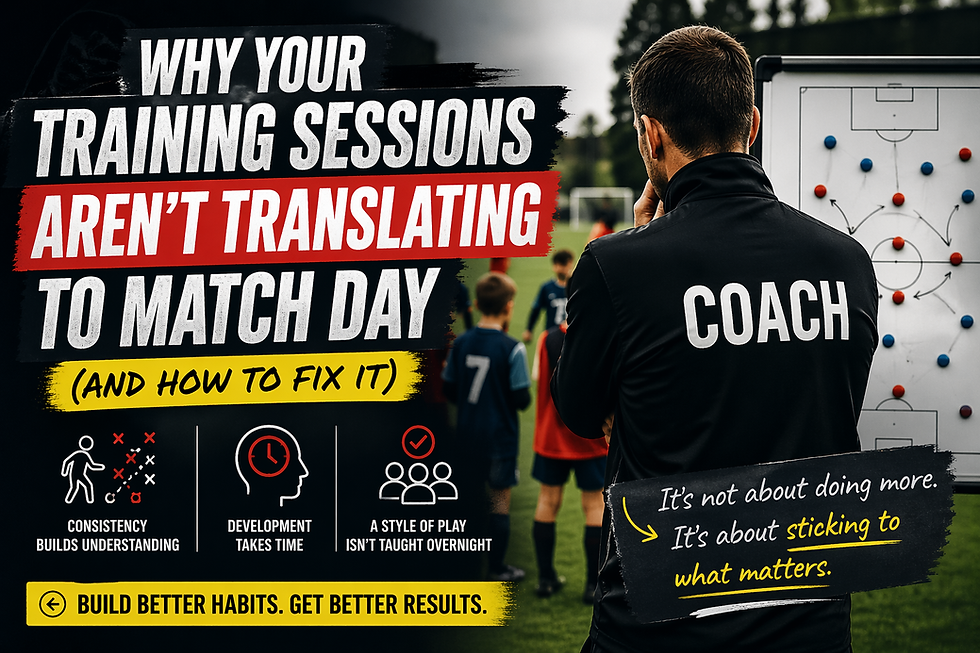
There’s a familiar feeling that creeps in for most grassroots coaches at some point during the season.
You walk off the training pitch midweek quietly pleased with yourself. The session flowed, the players were engaged, the passing looked sharp, and for a moment you allow yourself to think, “That’s it… we’ve cracked something here.” Fast forward a few days to match day, and within minutes that confidence begins to unravel. The ball won’t stick, players look unsure, and the very thing you thought you had improved suddenly feels miles away again.
It’s frustrating, and more than that, it’s confusing.
After all, you did work on this. The session was good. The players got it… didn’t they?
The reality is, the problem rarely sits in the quality of a single session. In fact, most grassroots coaches run far better sessions than they give themselves credit for. The real issue lies in something much less obvious, but far more important: a lack of continuity over time.
The trap most coaches fall into (without realising it)
At grassroots level, it’s incredibly easy to fall into the habit of planning sessions week by week. One week you focus on passing combinations, the next on defending shape, then perhaps finishing, then back to possession. On paper, it looks like you’re covering all the key areas of the game and in a sense, you are.
But here’s the problem: your players aren’t building anything.
Instead, they’re constantly resetting.
From a coaching perspective, it feels productive. You’re ticking boxes, introducing new ideas, keeping things fresh. But from a player’s point of view, it’s a bit like trying to read a book by jumping to a different chapter every time you open it. You might enjoy each individual part, but you never quite grasp the full story.
And football, at its core, is all about understanding the story of the game.

Why “we did this in training” doesn’t mean much on match day
One of the biggest misconceptions in coaching is the idea that exposure equals understanding. Just because players have done something in training doesn’t mean they’ve learned it in a way that will hold up under pressure.
Training, especially when structured and controlled, can give the illusion of progress. Passes look crisp, movements seem coordinated, and players appear confident. But matches are a completely different environment. They’re unpredictable, faster, and full of decisions that need to be made in a split second.
Under that kind of pressure, players don’t reach for what they’ve recently been told they fall back on what they genuinely understand.
And genuine understanding takes time.
It’s built through repetition, through mistakes, through revisiting the same ideas in slightly different ways until they begin to feel natural rather than forced. Without that repetition, even the best-designed session can fade quickly once the whistle blows.
Style of play isn’t taught in a session... it’s built over weeks
Every coach, whether consciously or not, is trying to develop a way of playing.
You might want your team to build from the back, stay composed in possession, use the width of the pitch, or press aggressively when they lose the ball. These are all great intentions but they aren’t things you can install in a single evening.
They require patience.
They require consistency.
And perhaps most importantly, they require the willingness to stick with something even when it doesn’t look perfect straight away.
The strongest grassroots teams aren’t necessarily the ones who know the most drills or cover the most topics. They’re the ones who have a clear identity and give their players enough time to grow into it. You can see it in how they play... the decisions look calmer, the movements more natural, and there’s a sense that everyone is on the same page without needing constant instruction from the sidelines.
That doesn’t happen by accident. It happens because the coach has resisted the urge to constantly change direction.
The uncomfortable part: development often looks messy
This is where many coaches understandably struggle.
You introduce a focus let’s say playing out from the back and in the first couple of games, it doesn’t go smoothly. Players make mistakes, goals might be conceded, and it can feel like you’re making things worse rather than better.
The temptation at that point is to abandon it and move on to something else.
But that’s the moment where the real development is just beginning.
Learning in football isn’t linear. Players rarely go from “not understanding” to “executing perfectly” in a straight line. Instead, they go through a phase where they’re trying to apply something new, getting it wrong, adjusting, and gradually improving. It’s uncomfortable to watch at times, but it’s a necessary part of the process.
If you constantly switch focus at that stage, players never get past the messy middle. They’re always starting, but never quite arriving.
So what should you do differently?
The shift isn’t about reinventing your sessions or making them more complicated. In fact, it’s quite the opposite.
It’s about thinking beyond the individual session and starting to see your coaching in blocks.
Instead of asking, “What should I do this week?”, a better question might be, “What do I want my team to get better at over the next month?”
Once you have that answer, your sessions begin to connect. Each one builds on the last, reinforcing the same ideas in slightly different ways. Players start to recognise patterns, not just within a session, but across multiple weeks. The concepts begin to stick because they’re no longer new, they’re familiar.
And familiarity, in football, breeds confidence and fluidity.
The moment it all starts to come together
If you stay patient with this approach, there comes a point where things begin to shift.
It’s not always dramatic. There’s no big turning point where everything suddenly clicks at once.
Instead, it shows up in small, almost unnoticed moments. A player receives the ball under pressure and stays composed. A defender opens their body and looks to play rather than clear. A midfielder takes up a position you’ve been encouraging for weeks without needing a reminder.
Those moments are easy to miss if you’re only looking at results.
But they’re the clearest signs that your training is finally translating.
Not because you’ve told them what to do. But because they’ve started to understand it for themselves.

Where this becomes even more powerful
Of course, staying consistent as a coach is one thing but actually tracking whether it’s working is another challenge altogether.
It’s easy to feel like your team is improving, but much harder to objectively see it over the course of a season. Are players really getting equal opportunities? Are your decisions on match day aligning with what you’re trying to build in training? Are the same players always on the pitch during key moments?
These are the small details that shape development over time, and without a way to track them, they often go unnoticed.
That’s exactly why tools like PlayTracker can make such a difference. Instead of guessing, you can see clearly how your players are being used across matches, helping you stay aligned with your coaching intentions and ensuring the habits you’re building in training are actually showing up where it matters most.
Because consistency isn’t just about what you coach midweek… it’s about what happens when the game starts.
Conclusion
It’s easy to fall into the mindset that better sessions will lead to better performances. And while quality does matter, it’s only part of the picture.
What truly makes the difference is consistency over time.
Giving your players the chance to revisit ideas, to struggle with them, to improve, and eventually to own them. That’s where real development happens, not in isolated sessions, but in the connections between them.
So if things aren’t quite showing up on match day yet, it might not be a sign to change direction.
It might simply be a sign to stay the course a little longer.


Comments