
The Complete Guide to Football Coaching Session Themes
Updated: Aug 20

100 Session Themes Every Grassroots Coach Should Know
Every great training session begins with a clear objective.
Whether you're coaching an Under-7 grassroots team or an adult side competing every weekend, choosing the right session theme is one of the most important decisions you'll make as a coach.
This guide brings together 100 of the most valuable football coaching session themes into one practical resource. Each theme includes a one liner to help you understand the aim and how it could fit in with your training.
Rather than searching for random drills, use these themes to build sessions that develop players and establish a clear playing identity.
What Is a Football Coaching Session Theme?
Your theme is the primary objective you want your players to improve during a training session. Rather than simply selecting a collection of drills, an effective coach starts by identifying a specific aspect of the game that needs developing, then builds every activity around that objective.
For example, instead of planning a session around a passing drill, a coach might choose Playing Out From the Back as the theme. The warm-up, technical practice, opposed exercise and game-related activity would all reinforce the same behaviours, giving players repeated opportunities to practise the decisions and movements required in real matches.
This approach creates purposeful training. Every exercise has a reason, every coaching intervention supports the same objective, and players leave the session with a clear understanding of what they have learned.
Session Themes vs Drills
One of the biggest mistakes coaches make is planning sessions around drills instead of outcomes.
A drill is simply a way of practising.
A session theme is what you are trying to develop.
For example:
Drill: 4v2 Rondo
Theme: Playing Under Pressure
The same rondo could be used to improve scanning, first touch, support angles, quick passing or pressing resistance depending on the coaching focus. The exercise itself hasn't changed... only the learning objective has.
The best coaches don't ask, "What drill should I run tonight?"
They ask, "What do my players need to improve?"
Once that question is answered, choosing the right practices becomes much easier.
Why Session Themes Matter
Using clear session themes helps players develop far more effectively over the course of a season because every training session contributes to a wider learning journey.
Well-planned themes help coaches to:
Create training sessions with a clear purpose.
Connect every activity to the same learning objective.
Build player understanding week after week.
Develop a recognisable team identity and playing style.
Measure progress more effectively over time.
Prepare players for the challenges they face on match day.
Rather than coaching isolated skills, session themes allow coaches to develop complete footballers who understand when, where and why to use those skills within the game.
Building Themes Across a Season
Session themes shouldn't exist in isolation. The strongest season plans build progressively, with each topic reinforcing previous learning before introducing new concepts.
For example, a youth team might progress through themes such as:
Passing & Receiving
Support Angles
Playing Out From the Back
Breaking the Press
Switching Play
Creating Overloads
Penetration in the Final Third
Each theme builds naturally on the last, helping players gain confidence before tackling more complex tactical concepts.
By the end of the season, players aren't simply better at individual techniques, they understand how those techniques combine to solve problems during a match.
That's why the most successful coaches don't just collect drills; they build a curriculum that gives every session a clear purpose.
How to Use This Guide
This guide has been designed as a practical reference for coaches at every level of the grassroots game.
Rather than reading from start to finish, you can return to it whenever you're planning a session, looking for new coaching ideas or searching for inspiration throughout the season.
The guide is organised into five key categories:
Technical Themes - Developing individual skills such as passing, receiving, finishing, dribbling and ball mastery.
Attacking Themes - Helping teams create chances, keep possession and score more goals.
Defensive Themes - Improving pressing, organisation, compactness and defending as individuals and as a team.
Tactical Themes - Building game understanding, decision-making and team identity.
Physical & Psychological Themes - Developing the athletic and mental qualities that underpin consistent performance.
Each of the 100 themes follows the same simple format so you can quickly find the information you need.
Use This Guide Your Way
Whether you're planning your next training session, creating a season-long coaching programme or simply looking for fresh ideas, this resource is designed to help you coach with greater purpose.
You don't need to work through every theme in order. Start with the areas that will have the biggest impact on your players, revisit themes as your team develops, and adapt them to suit your own coaching philosophy.
Remember, the most effective sessions aren't necessarily the most complicated, they're the ones where every activity supports a single, clear objective. Master the themes, and your session planning will become simpler, more consistent and far more effective.
Part One: Technical Themes
Technical development is the foundation of every footballer's journey. Regardless of age or ability, players need the confidence to control, manipulate and use the ball effectively before they can execute tactical ideas or solve complex game situations.
The themes below cover the essential technical skills every coach should consider throughout a season. Some are ideal as primary objectives for younger players, while others become increasingly important as players mature. Together, they provide a structured roadmap for developing technically capable footballers.
1. Ball Mastery
Develop confidence, coordination and close control by encouraging players to manipulate the ball comfortably using both feet.
2. First Touch
Improve a player's ability to control the ball positively, creating time and space for the next action.
3. Passing & Receiving
Build accurate passing, intelligent movement and quality receiving to help teams retain possession and progress the ball.
4. Dribbling
Develop confidence to beat opponents through close control, changes of direction and creativity in possession.
5. Running With The Ball
Teach players to recognise space and carry the ball forward at speed while maintaining control.
6. Turning
Improve players' ability to escape pressure using effective turns, changes of direction and body positioning.
7. Shielding The Ball
Develop the technique and awareness required to protect possession under pressure using body position and balance.
8. 1v1 Attacking
Build confidence and decision-making when taking on defenders in isolated attacking situations.
9. Crossing
Improve the quality, timing and variety of crosses delivered into dangerous attacking areas.
10. Finishing
Develop composed and consistent finishing techniques from different distances, angles and game situations.
11. Heading
Teach safe and effective heading technique for both attacking and defensive situations.
12. Volleying & Half-Volleys
Improve striking technique when finishing or clearing balls before they reach the ground.
13. Combination Play
Encourage quick passing combinations, one-twos and supporting movements to break defensive lines.
14. Weak Foot Development
Increase players' confidence and effectiveness by encouraging regular use of their non-dominant foot.
15. Ball Striking
Develop the technique required to strike the ball with power, accuracy and consistency using different methods.
16. Scanning
Help players gather information before receiving possession so they can make quicker, better decisions.
17. Decision Making
Improve a player's ability to choose the most effective technical action based on the situation in front of them.
18. Receiving Under Pressure
Develop composure and technical quality when controlling the ball while being challenged by opponents.
19. Switching Play
Teach players how to move the ball quickly and accurately to exploit space on the opposite side of the pitch.
20. Goalkeeper Distribution
Develop goalkeepers' ability to start attacks with accurate throws, kicks and intelligent decision-making.

Become a Football Hub Member and get instant access to our growing library of ready-to-use training sessions, coaching drills, tactical guides and downloadable resources. Spend less time planning and more time developing your players.
Plan smarter. Coach with confidence.
Part Two: Attacking Themes
Attacking football is about more than simply scoring goals. The best attacking teams create space, move opponents out of position, support one another and recognise when to play quickly or patiently. Effective attacking sessions should encourage creativity while helping players understand how their individual actions contribute to the team's overall style of play.
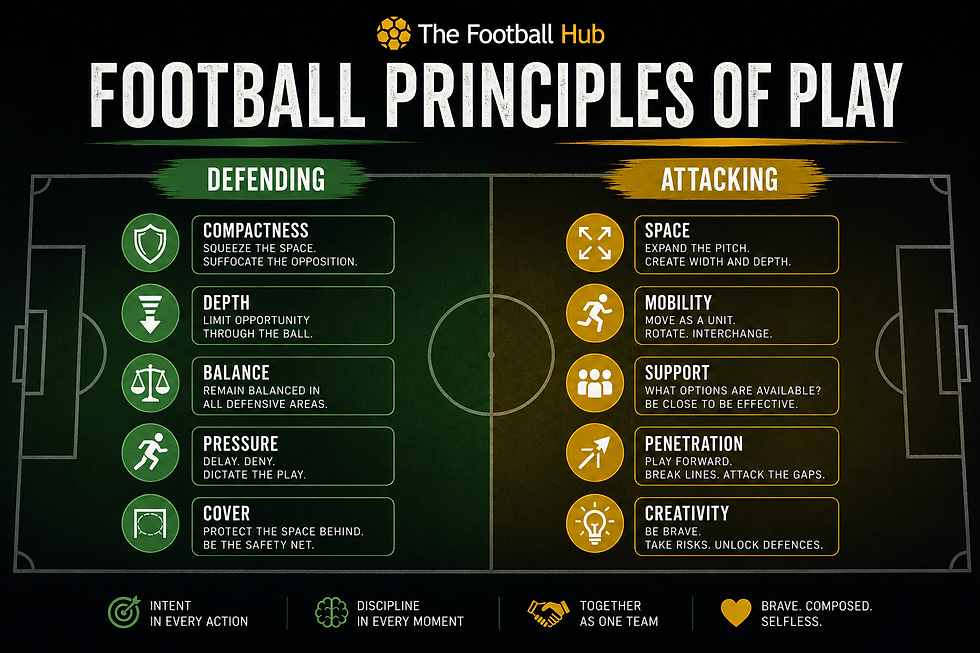
The themes below focus on developing the key attacking principles and behaviours that allow teams to build possession, create chances and score more consistently. If you want to learn more about the Attacking Principles of Play, give our full article a read on Mastering Attacking Principles of Play: Creating Space, Overloads, and Scoring Opportunities.
21. Playing Out From The Back
Develop the confidence and decision-making required to build attacks through controlled possession from defensive areas.
22. Breaking The Press
Teach players how to recognise and exploit spaces created by an opponent's pressing strategy.
23. Switching Play
Encourage players to move the ball quickly from one side of the pitch to the other to create space and unbalance the opposition.
24. Creating Width
Develop an understanding of how stretching the pitch creates passing lanes and attacking opportunities.
25. Penetration
Help players recognise the right moments to play forward quickly and attack space behind defenders.
26. Third Man Runs
Improve supporting movement by encouraging players to create passing options beyond the immediate receiver.
27. Creating Overloads
Teach players how to create numerical advantages in different areas of the pitch.
28. Counter Attacking
Develop the speed, decision-making and movement required to attack quickly after regaining possession.
29. Final Third Play
Improve the quality of attacking decisions and execution in areas where chances are created and goals are scored.
30. Crossing & Finishing
Develop coordinated movement between wide players and attackers to create high-quality scoring opportunities.
31. Through Balls
Improve players' vision, timing and weight of pass when playing beyond the defensive line.
32. Supporting Angles
Teach players to provide constant passing options by creating effective angles around the player in possession.
33. Movement Off The Ball
Develop intelligent movement that creates space for both the individual and teammates.
34. Creating Space
Help players understand how movement, positioning and timing can open gaps within organised defences.
35. Rotations
Develop positional interchange and coordinated movement to disrupt defensive organisation.
36. Playing Between The Lines
Teach players to receive and play in the spaces between the opposition's midfield and defensive units.
37. Forward Runs
Encourage players to make positive, well-timed runs beyond defenders to stretch the opposition.
38. Combination Play In The Final Third
Improve attacking fluidity through quick combinations, overlaps and creative link-up play near goal.
39. Attacking Transitions
Develop players' ability to recognise opportunities immediately after winning possession and attack with purpose.
40. Creating & Exploiting Space
Teach players to identify, create and attack space through intelligent movement, passing and decision-making.

Great coaching doesn't stop when the whistle blows.
PlayTracker is your matchday assistant, helping you manage playing time fairly, organise substitutions, and track goals, assists and key match events all from your phone and free to join.
Spend less time worrying about who should come on next and more time focusing on the game.
Manage every match with confidence using PlayTracker.
Part Three: Defensive Themes
Strong defending isn't simply about preventing goals... it's about regaining possession, protecting dangerous areas and working collectively to make the game difficult for the opposition. Great defensive teams understand when to press, when to delay, when to stay compact and when to recover.
The themes below help coaches develop players who defend intelligently as individuals and as part of a team. Whether you're working on 1v1 defending or organising your team's defensive shape, these themes provide a clear focus for purposeful training sessions. If you want to learn more about the Defensive Principles of Play, check out our full article Mastering Defensive Principles of Play: Compactness, Depth, and Organisation.
41. High Press
Develop the organisation, intensity and communication required to win the ball high up the pitch.
42. Mid Block
Teach players how to remain compact while controlling central spaces and forcing opponents into less dangerous areas.
43. Low Block
Develop patience, discipline and defensive organisation when protecting space close to goal.
44. Delaying The Attack
Help defenders slow down attacking players, allowing teammates time to recover and regain defensive shape.
45. Defensive Compactness
Improve the team's ability to reduce space between players and units, making it difficult for opponents to play through.
46. Cover & Support
Teach players how to provide defensive support behind teammates by covering dangerous spaces and anticipating the next action.
47. Defensive Balance
Develop an understanding of positioning that protects against switches of play, counter-attacks and overloads.
48. Recovery Runs
Improve players' reactions and movement when transitioning quickly from attack to defence.
49. Counter Pressing
Develop the habit of applying immediate pressure after losing possession to regain the ball quickly or slow the opposition's attack.
50. Defending Wide Areas
Teach players how to prevent crosses, delay attacks and defend effectively near the touchline.
51. Defending Crosses
Develop positioning, communication and decision-making when defending deliveries into the penalty area.
52. Defending Set Pieces
Improve organisation, marking responsibilities and reactions during corners, free kicks and throw-ins.
53. Press Triggers
Help players recognise the moments that should trigger coordinated team pressure.
54. Protecting The Penalty Area
Develop disciplined defending around the box by limiting shooting opportunities and blocking dangerous passing lanes.
55. 1v1 Defending
Teach defenders to control distance, body position and timing when facing an attacker individually.
56. Defensive Shape
Improve team organisation by maintaining effective distances and positioning both in and out of possession.
57. Winning Second Balls
Develop anticipation, aggression and reactions to regain loose balls following tackles, clearances or aerial duels.
58. Tracking Runners
Help players recognise and follow attacking runs while maintaining awareness of both the ball and their direct opponent.
59. Defensive Transitions
Develop quick reactions after losing possession to recover shape, apply pressure and prevent counter-attacks.
60. Defensive Communication
Encourage constant verbal and visual communication to improve organisation, decision-making and collective defending.
Part Four: Tactical & Game Understanding Themes
Technical ability gives players the tools to play, but tactical understanding helps them make better decisions throughout a match. As players develop, they must learn not only how to execute skills, but also when, where and why to use them.
The themes below focus on helping players understand the game as a whole. From maintaining possession and recognising transitions to controlling the tempo and adapting to different opponents, these topics develop football intelligence and create teams that play with greater purpose.
61. Possession Play
Develop patience, composure and intelligent movement to retain the ball while creating opportunities to progress forward.
62. Transition Play
Help players recognise and react quickly to the moments when possession changes, whether attacking or defending.
63. Playing Through Midfield
Teach players how to build attacks through central areas using movement, support and intelligent passing.
64. Wide Play
Develop an understanding of when and how to use the wide areas to stretch the opposition and create attacking opportunities.
65. Build-Up Play
Improve the team's ability to progress the ball from defensive areas into advanced positions through structured possession.
66. Game Management
Teach players how to control different phases of a match, adapting their decisions to the score line, momentum and remaining time.
67. Switching The Tempo
Help players recognise when to slow the game down and when to increase the speed of play to exploit opportunities.
68. Playing Against Different Formations
Develop players' understanding of how to adapt when facing teams using different tactical systems and shapes.
69. Press Resistance
Improve composure, movement and decision-making when playing against aggressive pressing teams.
70. Team Shape
Teach players how to maintain effective positioning in both possession and out of possession.
71. Exploiting Numerical Advantages
Develop an understanding of how to identify and use overloads in different areas of the pitch.
72. Ball Retention
Encourage players to value possession by making intelligent decisions under pressure.
73. Playing Between The Lines
Help players identify and exploit spaces between opposition units to create attacking opportunities.
74. Breaking Defensive Lines
Develop the vision, movement and passing required to penetrate organised defensive structures.
75. Controlling Space
Teach players how positioning, movement and spacing influence both attacking and defensive success.
76. Tactical Flexibility
Develop players' ability to adapt to changing situations, systems and opposition strategies during matches.
77. Rest Defence
Help teams maintain defensive security while attacking to reduce vulnerability during transitions.
78. Creating Passing Lanes
Teach players how movement and positioning create clearer passing options and improve ball progression.
79. Decision Making Under Pressure
Develop quicker, more effective decisions when players have limited time and space.
80. Match Intelligence
Encourage players to recognise patterns, solve problems and make smarter decisions throughout every phase of the game.
Part Five: Team Development & Coaching Themes
Great coaches develop more than footballers—they develop confident individuals, resilient teams and positive learning environments. While technical ability and tactical understanding are essential, long-term player development also depends on communication, leadership, mindset and creating a culture where players enjoy learning and challenging themselves.
The themes below focus on the qualities that help teams perform consistently both on and off the pitch. They encourage coaches to think beyond the next match and instead build players who are confident, accountable and prepared to keep improving throughout the season.
81. Communication
Develop players' ability to communicate clearly and positively to improve teamwork, organisation and decision-making.
82. Leadership
Encourage players to lead through their attitude, actions and communication, regardless of whether they wear the captain's armband.
83. Confidence
Create training environments that help players trust their ability and express themselves without fear of making mistakes.
84. Teamwork
Develop an understanding that success comes from working together, supporting teammates and contributing to collective goals.
85. Decision Making
Improve players' ability to recognise situations quickly and consistently choose the most effective solution.
86. Concentration
Help players maintain focus throughout training and matches, particularly during key moments of the game.
87. Resilience
Teach players how to respond positively to mistakes, setbacks and difficult moments while continuing to compete with confidence.
88. Match Preparation
Develop effective routines before matches that prepare players physically, mentally and tactically for performance.
89. Warm-Ups
Design purposeful warm-ups that prepare players for the demands of training or competition while reinforcing technical quality.
90. Recovery
Promote good recovery habits to support player wellbeing, reduce fatigue and prepare for future training sessions.
91. Goal Setting
Encourage players and teams to set realistic, measurable objectives that support continuous improvement throughout the season.
92. Reflection
Develop self-awareness by encouraging players to review performances, celebrate successes and identify areas for improvement.
93. Team Identity
Help players understand and embrace the values, behaviours and playing style that define the team.
94. Training Intensity
Create sessions that consistently challenge players while matching the demands of competitive football.
95. Coach Feedback
Deliver constructive, specific and timely feedback that encourages learning rather than simply correcting mistakes.
96. Learning Through Games
Use conditioned and small-sided games to create realistic learning opportunities where players solve problems independently.
97. Problem Solving
Encourage players to think for themselves, make decisions and adapt to changing situations without relying on constant instruction.
98. Competitive Mindset
Develop a healthy desire to compete by encouraging effort, resilience and a commitment to continuous improvement.
99. Player Ownership
Empower players to take responsibility for their development, decision-making and contribution to the team.
100. Enjoyment & Lifelong Learning
Create an environment where players enjoy the game, remain curious and develop a lifelong passion for learning and improving.

Enjoy 12 months of access to our complete coaching library for just £34.99, plus receive our 6 Week Pre-Season Program (worth £14.99) completely FREE.
Plan smarter, coach with confidence, and prepare your team for success all season long.
Join today and unlock everything The Football Hub has to offer.
How to Build a Season Using These Themes
One of the biggest mistakes coaches make is trying to cover too many objectives in a single session. Players learn best when every activity reinforces one clear theme, allowing them to practise the same behaviours repeatedly in different situations.
Rather than selecting random drills each week, use these 100 themes to build a structured learning journey throughout your season. As players become confident in one area, gradually introduce new challenges that build upon their existing knowledge and experience.
Below is an example of how you might structure your coaching focus across a typical season.
Season Phase | Suggested Session Themes |
Pre-Season | Ball Mastery, Passing & Receiving, Team Identity, Communication, Build-Up Play |
Early Season | First Touch, Defensive Shape, Creating Width, Supporting Angles, Transition Play |
Mid-Season | Breaking The Press, Playing Between The Lines, Counter Pressing, Game Management, Final Third Play |
Late Season | Match Preparation, Set Pieces, Match Intelligence, Competitive Mindset, Reflection |
Remember, this isn't a fixed programme. Every team is different, and your coaching themes should reflect the age, ability and needs of your players. If your team struggles to defend crosses, spend more time developing that area. If they lack confidence in possession, revisit technical themes before moving on to more advanced tactical concepts.
The most successful coaches don't simply collect hundreds of drills, they build a clear learning pathway that helps players improve week after week. If you're interested in building out your season plan, check out our full article Unlocking Peak Performance: A Guide to Periodisation in Football.
Final Thoughts
Great coaching isn't about delivering the most complicated session or using the latest training exercise you've seen online. It's about identifying what your players need most, choosing a clear objective and creating an environment where they can learn through repetition, challenge and enjoyment.
Whether you're coaching your first grassroots team or leading an experienced senior squad, these 100 session themes provide a framework that can help bring greater structure, consistency and purpose to your planning.
Return to this guide whenever you need inspiration, use it to shape your season and adapt the themes to suit your own coaching philosophy. Football is constantly evolving, but purposeful coaching will always remain at the heart of player development.
Continue Your Coaching Journey
If you're looking to turn these themes into complete training sessions, explore The Football Hub's growing coaching library. Inside you'll find ready-to-use session plans, practical coaching resources, tactical guides and downloadable content designed to save you planning time while helping you deliver engaging, purposeful training sessions.
Every great session starts with a clear theme. Every great season starts with a clear plan.


Comments