
Football Principles of Play: The Complete Guide for Grassroots Coaches
Updated: Aug 20
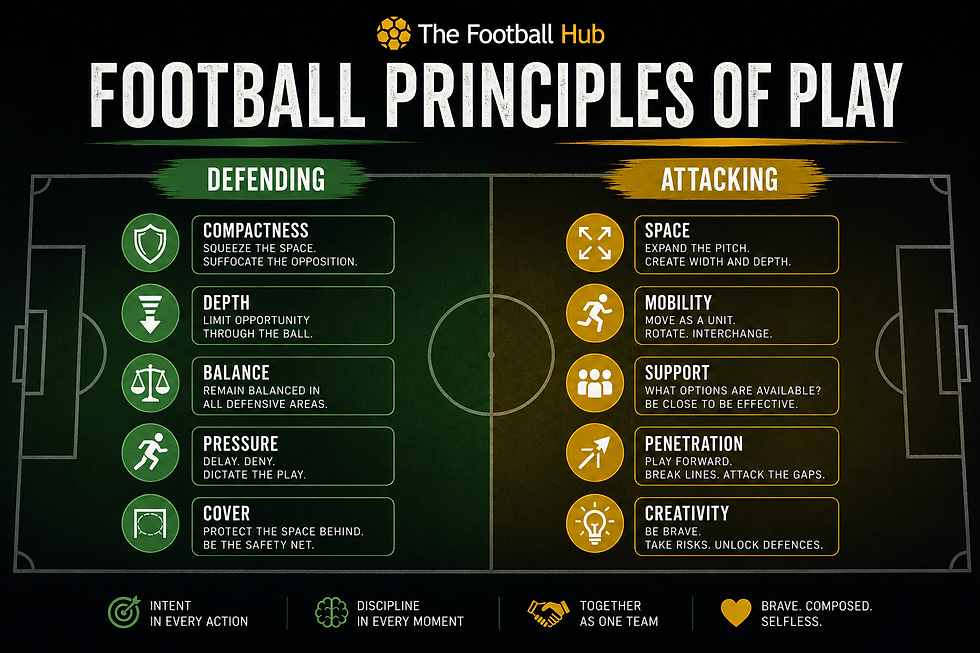
If you asked ten coaches what formation they play, most would answer immediately.
Ask those same coaches what their team's principles of play are…
…and many would struggle.
That's because formations tell players where to stand.
Principles tell them how to play.
Whether you're coaching Under-8s or senior football, the best teams don't rely on tactics alone. They rely on behaviours that every player understands, regardless of the score, the opposition or the formation.
Your principles of play become your team's identity.
They influence every decision your players make:
When do we press?
When do we stay compact?
How do we build attacks?
How do we react after losing possession?
Without principles, training sessions become disconnected drills.
With principles, every practice has a purpose.
In this guide we'll break down the attacking and defensive principles every coach should understand, explain why they matter, highlight common mistakes, and show how you can coach them in your own sessions.
What Are Principles of Play?
Football principles are the key behaviours that guide players in different moments of the game.
Unlike formations, they don't tell players exactly where to stand.
Instead, they provide consistent rules that help players make better decisions.
Think of them as the team's operating system.
Your formation might change from a 4-3-3 to a 3-5-2.
Your players might change every season.
Your principles should remain largely the same.
For example:
Instead of saying...
"Play left back."
Your principle becomes...
"When we lose possession, recover centrally before pressing wide."
Or...
"When the ball reaches wide areas, attack the penalty box with numbers."
These principles can be applied to every age group and every playing style.
Why Principles Matter More Than Formations
One of the biggest mistakes coaches make is becoming obsessed with formations.
Youth football especially has become flooded with tactical discussions about 4-3-3, 3-5-2 and positional play.
The reality?
A perfect formation means very little if players don't understand what they're trying to achieve.
A team with excellent principles will often outperform a tactically sophisticated team whose players lack clear decision-making.
Great coaches don't coach positions.
They coach behaviours.
Ask yourself:
Can every player explain what happens when possession is lost?
Does everyone know where the support player should be?
Does everyone recognise pressing triggers?
If the answer is yes, your principles are becoming habits.
The Five Defensive Principles

Every defensive action should aim to make life more difficult for the opposition.
Rather than chasing the ball individually, successful teams defend collectively.
1. Compactness
Objective
Reduce the space available to play through.
The closer your players are to one another, the fewer passing lanes the opposition can find.
Compact teams:
✓ Stay connected.
✓ Protect central areas.
✓ Force opponents into predictable passes.
What It Looks Like
When the opposition plays through midfield, your midfield and defensive units move together.
There are no large gaps between players.
The ball carrier constantly sees bodies.
Common Coaching Mistakes
❌ Players pressing individually.
❌ Huge distances between midfield and defence.
❌ Leaving central spaces exposed.
Coaching Challenge
Play a small-sided game where teams only score if they win possession inside the middle third.
Players quickly learn the value of staying compact.
2. Depth
Objective
Protect the space behind the defensive line.
Depth ensures that if one defender is beaten, another player is already in position to recover.
Without depth:
through balls become dangerous
pace becomes difficult to defend
one mistake leads directly to goal
Coaching Questions
Is someone protecting the space behind?
Can we delay before diving in?
3. Balance
Football isn't defending where the ball is.
It's defending where the ball might go next.
Balance means protecting the opposite side of the pitch and anticipating switches of play.
The best defenders scan constantly, considering where the threat is most likely to come from.
They're already preparing before the pass is played.
Common Error
Everyone shifts toward the ball.
The far side becomes completely open.
4. Pressure
Pressure isn't about sprinting towards the ball.
It's about controlling what happens next.
Good pressure:
forces play backwards
forces play wide
dictates the opponent's next decision
Poor pressure creates space.
Smart pressure removes options.
Coaching Cue
"Don't win the ball first... control where they play first."
5. Cover
Pressure and cover always work together.
If one player engages...
Someone else protects.
Without cover, one missed tackle creates a clear chance.
With cover, mistakes become recoveries.
Bringing Defensive Principles Together
Notice how none of these principles work alone.
Compactness improves pressure.
Pressure relies on cover.
Balance supports compactness.
Good defending is simply five connected principles working together.
The Five Attacking Principles

Great attacking football isn't about tricks.
It's about creating more problems than the opposition can solve.
1. Space
Space is football's most valuable resource.
The best teams don't chase the ball.
They create space before they receive it.
Create width.
Create depth.
Stretch opponents until gaps appear.
2. Mobility
Static players are easy to mark.
Movement creates uncertainty.
Encourage:
rotations
overlaps
underlaps
third-man runs
checking short before spinning behind
Movement should always have purpose.
3. Support
Every player in possession should have options.
Support isn't standing close. It's arriving in useful positions.
Ask players:
"If your teammate receives now... can they play forwards, sideways and backwards?"
If not...
Support needs improving.
4. Penetration
Possession only matters if it creates opportunities.
Every attack should look for moments to:
play forward
split defensive lines
drive with the ball
attack space
Sometimes penetration is a pass. Sometimes it's a run. Sometimes it's simply committing a defender.
5. Creativity
The final principle is often forgotten. Players need permission to solve problems.
Not every action should be rehearsed.
The best environments encourage players to:
take risks
improvise
express themselves
learn through mistakes
Creativity cannot exist without confidence and risk.
Connecting Attack and Defence
The best teams understand that football never stops.
The game constantly moves between four moments:
Attacking
Losing possession
Defending
Winning possession
Every transition is an opportunity.
Can you counter-press?
Can you counter-attack?
Can you reorganise quickly?
The faster your players recognise these moments, the better your team becomes.
Coaching Principles by Age Group
U6–U10
Focus on:
Space
Support
Pressing
Enjoyment
Avoid over-coaching tactics. This is the age to lay the foundations with minimal explanation... think muscle memory.
U11–U14
Introduce:
Compactness
Switching play
Rotations
Combination play
Begin asking questions instead of giving answers.
U15+
Now players can understand:
pressing triggers
defensive blocks
overloads
positional rotations
game management
Planning Sessions Around Principles
One mistake many coaches make is planning sessions around drills.
Instead...
Plan around behaviours.
Example:
Theme - Creating Space
Warm-up - Movement to receive.
Practice - 4v4 plus neutral players.
Conditioned Game - Goals only count after a switch of play.
Match - Coach only the principle of space.
Everything links together.
Five Questions Every Coach Should Ask
Before every session ask yourself:
What principle are we coaching today?
How will players experience it?
How will I know they've understood it?
How does it connect to match day?
Will I coach behaviours instead of outcomes?
If you can't answer those questions...
Your session probably needs simplifying.
To Finish Off
Every successful team has an identity.
That identity isn't built by copying professional formations.
It's built by repeating simple principles every single week.
Players don't remember hundreds of drills. They remember consistent behaviours.
Teach your players:
when to press
how to support
how to create space
how to defend together
how to attack with purpose
Do that consistently...
…and you'll build something far more valuable than a formation.
You'll build a way of playing.
Keep Developing Your Coaching
At The Football Hub, our mission is simple: help grassroots coaches spend less time searching for ideas and more time developing players.
Explore our growing library of coaching articles, tactical graphics, session ideas and practical resources, all designed to make you a more confident coach.


Comments